









The complaint came from the office upstairs, not the workshop. A dental clinic had installed a compressor at the back of the building and everything about it was fine on paper: enough flow, right pressure, clean air. But the wall it sat against was shared with a reception desk, and within a week the reception staff were asking whether something was broken.
Nothing was broken. The unit was simply loud by design, and nobody had compared noise figures at purchase because nobody had read them properly. The spec sheet had said “72 dB” — which is like saying a car is “fast.” Compared to what, measured where, doing what?
Noise is one of the easiest specifications to get wrong and one of the most expensive to fix afterwards. This is how to read it.
dB(A) versus plain dB: why the A matters
Sound pressure level is measured in decibels, but the human ear does not hear all frequencies equally. We hear mid frequencies far better than very low or very high ones — a 50 Hz rumble and a 1 kHz whine register very differently even at identical physical pressure.
A-weighting applies a filter that approximates human hearing sensitivity, and the result is written dB(A). It is the standard used in occupational noise regulations and the only figure worth comparing between machines. If a supplier quotes “dB” with no letter, ask which weighting curve was applied — it is often a raw number that flatters the product.
A second thing worth knowing: the decibel scale is logarithmic. A 3 dB increase doubles the sound energy; a 10 dB increase roughly doubles perceived loudness. So moving a machine from 75 dB(A) to 68 dB(A) is not a modest 10% improvement. It is a large, audible one.
What the numbers mean in practice
| dB(A) | Rough equivalent | Context |
|---|---|---|
| 30–40 | Quiet library | Achievable only with dedicated enclosure and distance |
| 50–60 | Normal conversation | Acceptable in a shared room |
| 65–70 | Busy office, vacuum cleaner | Noticeable; fine for a room you pass through, not one you work in |
| 75–80 | Busy street, typical open-frame piston unit | Hearing protection territory over long exposure |
| 85+ | Heavy traffic | Regulatory action thresholds begin here |
Different jurisdictions draw their limits in different places, so check your local rule rather than any blog table — including this one. Two commonly cited reference points: many EU-derived regulations set the daily exposure limit value at 87 dB(A) with an upper action value at 85 dB(A) (lower action value 80), while the US OSHA permissible exposure limit is typically quoted as 90 dB(A) over an eight-hour day. Either way, the practical conclusion is the same: below about 70 dB(A) at the operator’s ear, noise stops being a compliance problem at all.
That is why a quiet unit is not a comfort feature. It is often the difference between putting the compressor in the building and building a shed outside.
Distance, direction and the “measured at one metre” trap
A sound level without a distance is meaningless. Standards generally specify free-field measurement at one metre, meaning outdoors or in an anechoic space with no reflected sound. Your room is neither.
Two rules make the difference:
- Distance. Every doubling of distance drops the level by roughly 6 dB. Moving a machine from one metre to four metres away is worth about 12 dB — usually more than any upgrade you could buy.
- Reflections and corners. A small room with hard walls adds reflected energy, typically several dB over the free-field figure. A unit in a corner radiates into a quarter of the space and is measurably louder there than in open floor.
So when comparing two machines, insist on the same measurement distance and conditions. A 70 dB(A) at one metre unit bolted into a tiled corner can read higher than a nominally louder machine mounted away from the wall on anti-vibration feet.
Where compressor noise actually comes from
Five sources, roughly in this order of contribution:
- The cooling fan. Often the dominant source once everything else is quieted — broadband air rush, worse when the fan is small and spinning fast.
- Intake pulsation. Drawing air in creates noise at the intake; a decent intake filter and silencer matters more than buyers expect.
- Structure-borne vibration. The machine shakes, the floor or wall amplifies, and the building becomes the speaker. This is what travels to the office upstairs, and it is why anti-vibration mounts punch above their cost.
- Motor and drive noise. Belt drives add a whine; direct drive removes it. Variable-speed drives also run quieter at part load because everything is turning slower.
- Air discharge and leaks. A leaking fitting or an undersized pipe hisses continuously. Worth remembering that the cheapest noise reduction available may be fixing your leaks.
Note how much of that list is installation rather than hardware. The same machine comes out of the crate sounding very different depending on where it stands and what it stands on.
Enclosures: the cheapest fix, and its trap
Putting a box around a compressor is genuinely effective — commonly worth 10 dB(A) or more with a well-designed enclosure. It is also the most common way to destroy a machine.
A compressor is a heat source. Enclosing it without ventilation raises intake temperature, which reduces output, raises discharge temperature and shortens motor life. Every enclosed installation needs:
- Inlet and exhaust ducting sized so intake air is drawn from outside the enclosure, not recirculated inside it.
- Ambient temperature kept within the manufacturer’s limit — commonly around 40 °C.
- Service access. An enclosure that has to be disassembled to change a filter will not be opened on schedule.
- Combination with isolation mounts, so the enclosure does not become a sounding board.
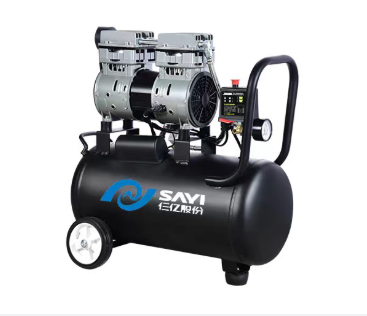
Purpose-built quiet packages solve most of this at the factory. Our SY-750 unit pairs an oil-free pump with silencing and a 200 L receiver in one cabinet, which removes both the pulsation and most of the fan noise rather than covering them up.
Choosing quiet technology rather than quiet accessories
The bigger decision is architecture, and here oil-free scroll has a structural advantage. Few moving parts, no intake pulsation stroke, no oil churn — the noise floor is lower before any silencing is added. For indoor occupied spaces, that generally beats a noisier piston unit wrapped in acoustic foam.
Our typical mappings:
| Application | Why quiet matters | Recommended starting point |
|---|---|---|
| Dental and medical | Staff and patients share the room | Oil-free & Mute range |
| Laboratories and instrumentation | Administrative staff nearby, continuous duty | Oil-free scroll range |
| Indoor workshops and light assembly | Operator proximity over a long shift | Silent piston or scroll with receiver |
| Food and beverage packaging | Hygiene plus indoor production staff | Oil-free scroll, IP54 option |
| Plant-wide factory supply | Usually a compressor house, so noise matters less | Rotary screw |
Note the middle column. A factory compressor room has completely different noise economics from a treatment room — and it is worth deciding which one you actually have before comparing figures.
Checklist before you buy on noise alone
- Ask for dB(A) at one metre, free field, and note whether there is a second figure in an enclosure.
- Ask whether it is measured loaded or unloaded. Loaded is louder and realistic.
- Confirm whether the figure is at the machine or at some distance from it.
- Plan ventilation for any enclosure, and keep the room within the machine’s stated ambient limit.
- Include anti-vibration mounts in the installation — they deal with structure-borne noise that no acoustic panel touches.
- Check whether your room adds reflections: hard walls, low ceilings and corners all push the real number above the quoted one.
- If the unit sits near people, prioritise low running speed: variable-speed drives run quieter at part load.
If you would rather not do this arithmetic alone, send the room dimensions, distance to the nearest occupied space and your flow requirement through the página de contacto and we will specify against it.
Perguntas frequentes
What dB(A) level counts as a quiet compressor?
There is no regulated definition of “quiet,” which is exactly why the term is freely abused. In practical terms, a package that reads below about 70 dB(A) at one metre can generally live in a shared building without additional hearing controls. Above roughly 80 dB(A), you want it separated from occupied space.
Why does the machine get louder than the brochure claimed?
Three usual reasons: the quoted figure was taken at a greater distance than one metre, taken unloaded, or taken free-field while your unit is installed in a corner with hard reflective surfaces. All three are common, and none of them are fraud — but all three make comparison impossible unless you ask.
Will an acoustic enclosure solve it?
Partly — expect a substantial reduction, commonly around 10 dB(A) from a well-built enclosure. It will not fix structure-borne vibration travelling through the floor, and it creates a heat problem that must be ventilated or you will trade a noise issue for a reliability issue.
Is an oil-free scroll unit automatically quieter?
Generally yes, because there is no reciprocating stroke and no oil churn, and motor and fan speeds are lower. The comparison worth making is against a similarly silenced machine, not against an open-frame piston set. Start from the gama de compressores scroll sem óleo and compare quoted dB(A) at the same distance.
Does fixing leaks really reduce noise?
Often more than any hardware change, and it pays twice — a persistent leak hisses at every work hour while simultaneously forcing the compressor to run longer. It is the first thing to check in any existing installation.
Related reading: our guides to installation practice e preventing summer overheating cover the ventilation side of locating a compressor indoors. For the wider selection question, see piston vs screw vs scroll.