




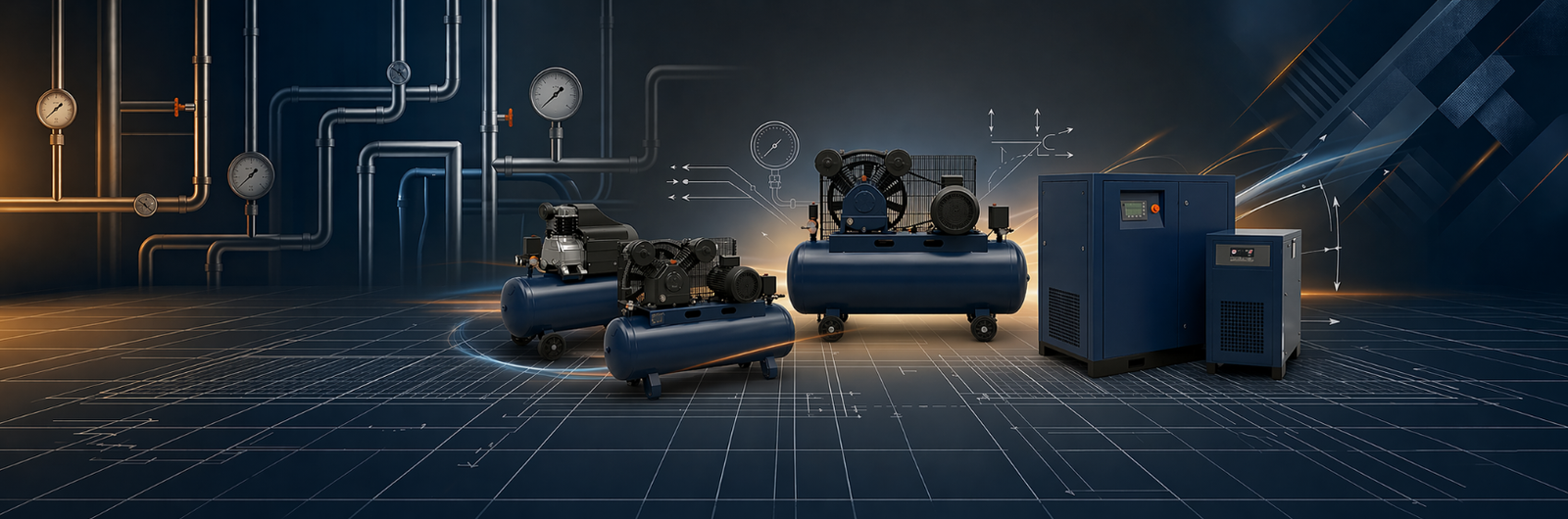
The box lands, gets wired, and the first press of the start button ends in a trip. Nobody ordered the wrong compressor. The supply is wrong.
That is the whole problem, and it is why the electrical page deserves the same reading as the flow rate instead of a glance and a signature.
This covers three phase industrial machines from about 4 kW to 75 kW, and the single phase units at the small end.
Two families, and a gap that looks small
The industrial world runs two grids, and neither is a variation on the other. Different animals.
Europe and China sit around four hundred volts on fifty hertz. North America runs sixty, and the number it uses is nothing like four hundred. That is why two quotations identical in the price column can produce two very different machines, and why nobody notices until the container is open and the electrician is standing there.
The values, and the tolerances around them, are set out in IEC 60038. What matters in a factory is shorter. A motor wound for one family does not settle into the other, however reasonable the arithmetic looks.
The tolerance is where people stop reading. Under IEC 60034-1 the voltage can sit 5 percent high or 5 percent low. Add frequency drift alongside it and the window opens to 10. Modest numbers. A site that sags to 350 V at start up is already outside them, and nothing fails cleanly when that happens. Nothing breaks on the spot either. The motor runs hot and the insulation quietly gives up a few years early.
What frequency does to a machine
Frequency is speed. Two poles, and the shaft turns at about 3,000 rpm on fifty hertz, 3,600 on sixty.
Twenty percent, and it runs through everything bolted to that shaft, including the fan that keeps the motor alive. That last part is where it gets expensive.
A sixty hertz machine on a fifty hertz supply makes less air, and its cooling fan slows down at the moment the winding needs it most. Nothing trips. It cooks quietly for two summers instead.
Go the other way and it fails differently. Airend faster, current higher, overload relay doing its job, and eventually a trip that looks like a fault and is really a specification error.
The parts that are not the motor
The motor is not alone in caring about any of this.
Coils in the solenoid valves, contactor coils, the cooling fans, the control transformer. All of them care about frequency to some degree, and not one of them appears on the page you compared prices on.
That is why the grid data gets asked for before the machine is built. After it is built, the answer is a rebuild.
A drive, and what it buys
A variable speed unit inserts a drive between supply and motor. That drive is what decouples them.
It rectifies whatever comes in and rebuilds it for the motor. One build covers a wider band of supply. The start is soft, and the six or seven times full load current that a direct on line start pulls for a second simply never happens.
The drive brings conditions of its own. Harmonics are a genuine problem. The industry answers them with IEC 61800-3 and IEC 61000-3-2, and expects you to know what they say. Put that drive on a weak supply, or next to sensitive electronics, and an input reactor or a DC choke stops being an option and becomes the thing that keeps you legal.
A drive is also less forgiving. A brownout that a direct on line motor would ride out will trip a drive that is busy protecting itself, and it will pick the least convenient moment.
Where single phase runs out
Four kilowatts is about the line.
Above it, three phase wins on every count that matters. A three phase motor is smaller for the same output, cheaper to buy, and more efficient. It also produces torque smoothly, with no start winding and no capacitor waiting to fail in August.
Below it, single phase is honest and fine. A workshop with a wall socket, a service van, a small scroll or piston unit built for that supply.
The trouble is stretching it. A 5.5 kW single phase motor asks for a current most domestic supplies were never sized for, and the cable is what gives up first, not the motor.
Past about 3 kW on single phase, the real options are a rotary converter, a drive with single phase input, or a diesel set. If a drive fits, take the drive. A rotary converter is one more machine to maintain and one more thing to fail on a Friday afternoon.
Phase order, which nobody checks
Three phase has no polarity, but it does have a sequence.
Swap two leads and the motor runs backwards. A fan tolerates that. A screw compressor does not.
The airend is built for one direction. Backwards, there is no oil pressure, the bearings are fed from the wrong side, and the damage starts inside a minute rather than over a month.
Every machine we ship carries a phase sequence check in the commissioning sheet. On site, the cheap version is a rotation meter held on the terminals before the first start. Before, not after.
Cable, and the drop nobody measures
Voltage drop is the electrical fault we get called about most.
Five percent from the origin out to the furthest socket is the usual allowance, with roughly 3 percent of that spent on the last leg. Current capacity sets the starting size for the installation method. Then check the drop over the actual length and see whether it goes up a step.
Put a clamp meter on a fully loaded 22 kW machine at 400 V and it reads about 40 A. Run that down fifty metres and the copper has to be thicker than it would be at ten. Undersize it and the motor starts badly on a hot afternoon, then never quite recovers.
Give us the distance from the board. We come back with the conductor size and the direct on line starting current, so your electrician works from that instead of habit.
The margin inside the winding
Windings are class F, 155 °C. The motor is designed around class B rise, which is 80 K above ambient.
That gap is deliberate margin. It is the reason a machine survives an afternoon in a room somebody should have ventilated properly.
Spend long enough above the rise and the margin is spent. The winding does not fail that week. It fails in year five, on the hottest day of the year, which is the day you needed the air.
What we need before building
Four things settle the specification. Nominal voltage and frequency. Phases. Available supply capacity, if anybody on site knows it. Site altitude, because thin air cools less and some clearances change with height.
A fifth beats all four. Photograph the nameplate of a machine already running on that supply. It tells us what the grid does, rather than what the form says it should.
We wind to what you specify, since the winding is chosen during assembly. What we cannot do at a sensible price is convert a finished 50 Hz machine into a clean 60 Hz build after it has sailed.
If the grid is genuinely uncertain, the small units in our oil free scroll compressor range come in the common single and three phase variants, and the larger machines in the screw air compressor range are wound to the nameplate you give us.
One mistake worth naming
A machine wound for 380 at 50 Hz is not going to be happy on 440 at 60, however close the two numbers look on paper.
Frequency decides speed. Voltage decides flux. Get either wrong and the winding is what pays. A transformer will fix the voltage and leave the frequency exactly where it was, which is how that shortcut ends in a burnt motor and a warranty argument.
Want a specification checked before the order? Send the grid details through the page de contact, altitude included if you know it. The about page covers what we build and where. We wind and test the motors here, so the answer comes back from the people doing the work.